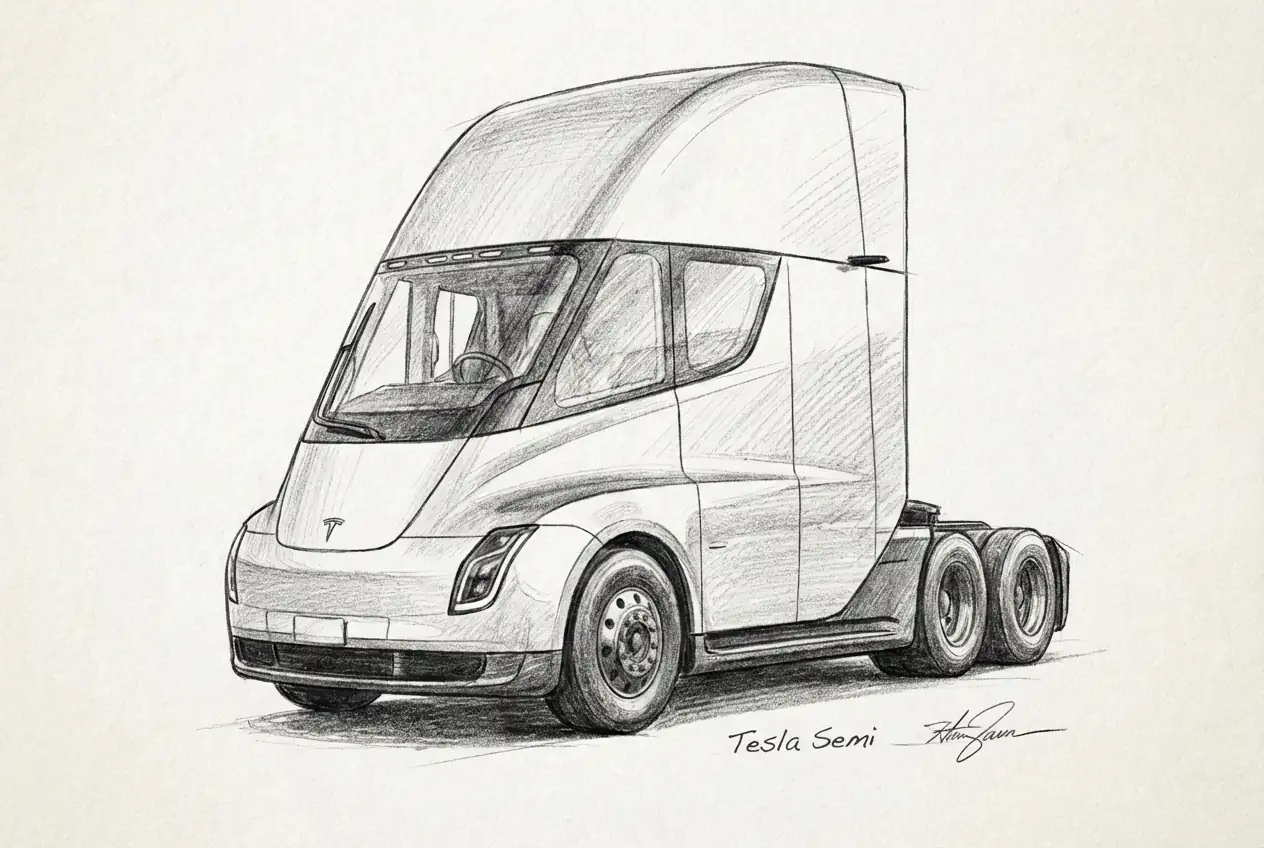
Shares surged nearly 4% to $371.61 on September 17 as Tesla announced a partnership with Forum Mobility to build and operate public heavy-duty charging stations at three California truck depots, adding 30 megawatts of capacity. A broader tech rally — the Nasdaq climbed 1.49% — amplified the move, but the charging news gave Tesla-specific fuel at a moment when investors are hungry for proof that the Semi truck program is real and scaling. Tesla's Megacharging Bet on Electric Trucking Just Got Real — But Is 30 Megawatts Enough to Justify the Hype?
Shares jumped 3.8% to $371.61 after Tesla announced it will operate public heavy-duty charging stations at three California truck depots built by Forum Mobility, a trucking infrastructure firm. A broader tech rally padded the move — the Nasdaq rose 1.49% — but the deal carries Tesla-specific significance as it attempts to prove that its long-delayed electric Semi can actually scale.
- The Charging Problem That Keeps Fleet Buyers on the Fence. For heavy-duty electric trucks, the limiting factor is often whether reliable, high-power charging exists where freight actually runs — not whether the trucks can be built.
The new depots will include pull-through charging lanes with next-generation megawatt-class technology alongside conventional fast chargers. By operating these sites itself, Tesla controls both the truck and the fuel stop — a vertical integration play that no legacy truckmaker can yet match.
- 330 Semi Commitments Signal Real Commercial Traction. Forum Mobility's Santa Fe site in Rancho Dominguez has commitments from fleet operators for more than 330 Tesla Semi trucks. That's notable because Tesla first announced the Semi in 2017, missed its delivery target seven consecutive times, and by late 2022 had barely exceeded 200 cumulative U.S. deliveries.
Tesla's Semi factory is designed for annual capacity of 50,000 trucks, though it will ramp gradually , and analysts project between 5,000 and 15,000 deliveries in 2026.
- The Financial Scale Remains Tiny Against a $906 Billion Industry. U.S. trucking generated an estimated $906 billion in gross freight revenue in 2024. Even at full list price — the Semi Long Range starts at $290,000 — 330 trucks represent roughly $96 million in hardware, a rounding error for a company with a $1.2 trillion market cap. The real investor thesis is that charging infrastructure locks in recurring energy revenue and makes fleet adoption self-reinforcing over time.
- Europe Is Next, Raising the Stakes on Execution. The charging expansion comes as Tesla prepares to broaden the Semi's availability beyond North America, with a European launch planned next year.
Bernstein recently concluded that the Tesla Semi now holds a 3% total-cost-of-ownership advantage over its diesel equivalent — meaningful in an industry where full-year profit margins typically run between 2% and 5%. If Tesla can replicate charging partnerships abroad, the economics could tip entire fleets toward electrification. But 30 megawatts across three sites is a pilot, not a network — and investors are pricing in far more than a pilot.