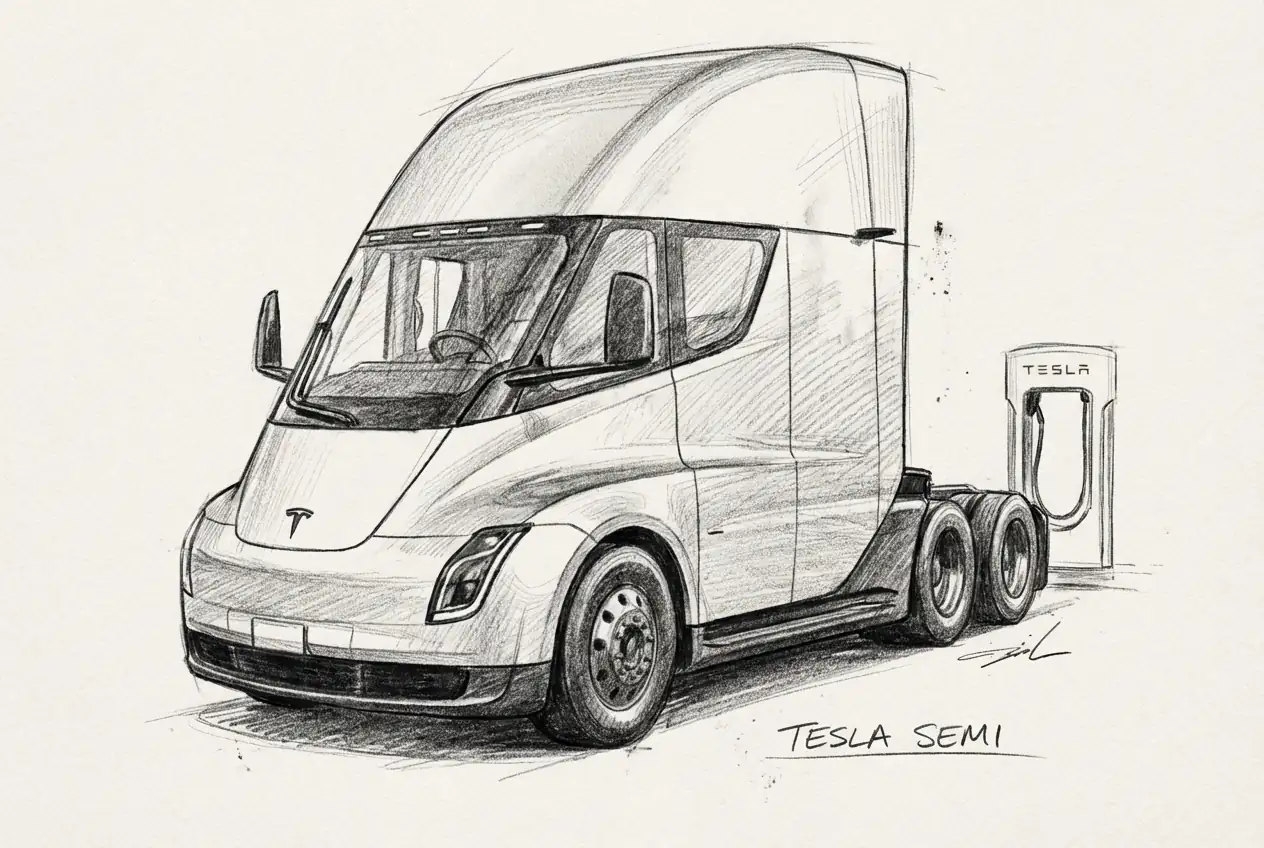
Shares of Tesla surged +2.9% to $306.80 after the company confirmed it will unveil European specifications and launch plans for its all-electric heavy-duty truck at the IAA Transportation show in Hannover, Germany, running September 15–20. The announcement is deliberately short on detail — no European range figures, pricing, or on-sale date yet — but the stock's sharp outperformance of broader markets signals investors see a credible new revenue stream taking shape.
A Nine-Year Wait Finally Gets a Date on the Calendar. The truck was first unveiled in 2017 and initially scheduled for production in 2019, but the launch was repeatedly delayed.
Mass production finally began this April in Nevada.
Despite a maximum factory capacity of 50,000 units per year, analyst estimates put full-year output at just 5,000 to 15,000 units — meaning Europe would draw from an already constrained supply. Whether Tesla can serve two continents simultaneously will determine how fast this revenue story develops.
The Market Is Huge but Heavily Defended. Europe's electric truck market is expected to grow from $4.4 billion in 2026 to $14.7 billion by 2035. But the top five incumbents — IVECO, Daimler, Renault Trucks, Scania, and Volvo — collectively held 65% market share in 2025.
Volvo has launched an electric long-haul truck with 600 km range this year , and Daimler secured a large electric heavy-duty order from a major European logistics operator in March 2026. Tesla enters with neither a European dealer network nor a charging infrastructure footprint against rivals already building one.
Price and Range Could Be the Wedge. In the U.S., Tesla is quoting $290,000 for the 500-mile long-range version and roughly $260,000 for the standard range — making it the lowest-priced Class 8 battery electric tractor on the market. If European pricing follows a similar playbook, it would undercut incumbents and attract cost-conscious fleet operators facing binding EU CO₂ reduction targets that make zero-emission trucks a legal requirement.
What Investors Still Don't Know. European fleet managers are awaiting local pricing, Megacharger infrastructure rollout plans, delivery timelines, and potentially a local production roadmap.
Getting a nearly 40-tonne electric truck onto European motorways requires meeting a completely different set of regulations and spatial constraints — meaning the September reveal must answer engineering questions, not just marketing ones. Until those details land, today's rally is built on promise, not proof.