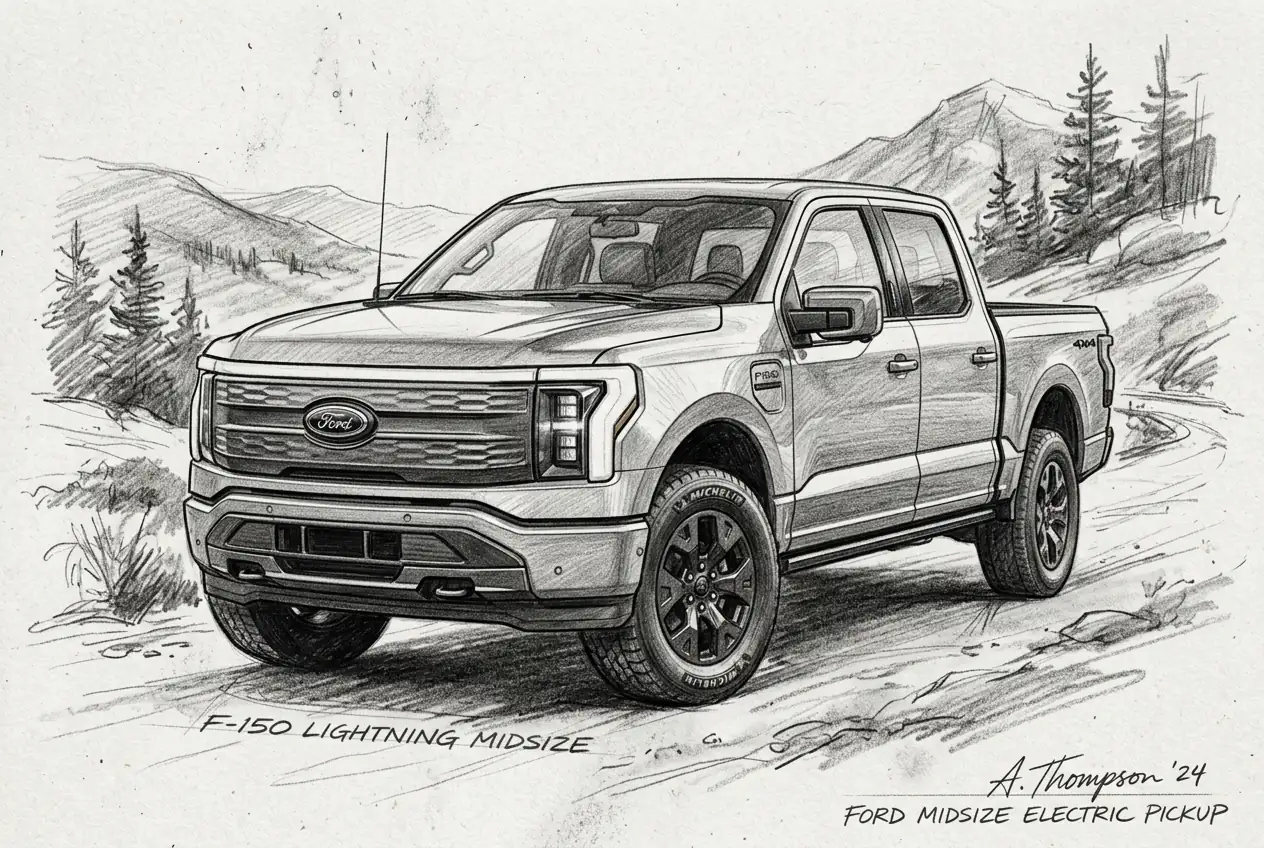
Shares of Ford jumped 4.2% to $12.18 on May 6 after CNBC reported from inside the automaker's secretive Long Beach, California development center, where engineers are pushing toward a 2027 launch of a roughly $30,000 midsize electric pickup truck — Ford's biggest bet to compete with Chinese rivals that CEO Jim Farley has called an "existential threat."
• Ford Is Spending $5 Billion to Reinvent How It Builds Cars
The investment will create nearly 4,000 new jobs in Kentucky and Michigan , centered on a brand-new manufacturing platform. The architecture uses 20% fewer parts and requires 40% fewer workstations during assembly.
Ford will use large castings that "condense over 146 parts into two." This isn't incremental improvement — it's an attempt to match how Tesla and Chinese automakers already build EVs, and it must work for Ford's EV division to stop hemorrhaging cash.
• The Company Is Still Losing ~$23,000 on Every Electric Vehicle It Sells
Ford's Model e unit reported a loss of $777 million in Q1 2026, an improvement of just $72 million from a year earlier.
The EV division lost $4.8 billion in 2025 , and Ford expects losses of $4.0 to $4.5 billion for Model e in 2026.
Ford doesn't expect to break even on EVs until 2029. Investors cheering today's news should recognize that the new truck must fundamentally reshape that math — selling profitably at $30,000 while current EVs lose money at $55,000.
• Chinese Competition Is Already at the Doorstep
BYD now sells 7 out of 10 electric and plug-in hybrid cars in Mexico , and Chinese startups are developing new vehicles in about 20 months — roughly half of Detroit's typical timeline. Ford's EV product leader acknowledged, "We only win with speed." U.S. tariffs currently shield Ford domestically, but that protection could shift with any trade policy change.
• The Market Rally May Be Doing the Heavy Lifting Ford's +4.2% move came alongside a broad rally — the Dow gained 1.12% and the Nasdaq 0.89%. The stock still sits below its $12.24 close from April 29, meaning this pop merely reverses recent weakness. Ford took a $19.5 billion charge in December as it revamped its EV strategy. Until the 2027 truck reaches production at scale — profitably — today's optimism remains a down payment on a promise, not proof of a turnaround.